

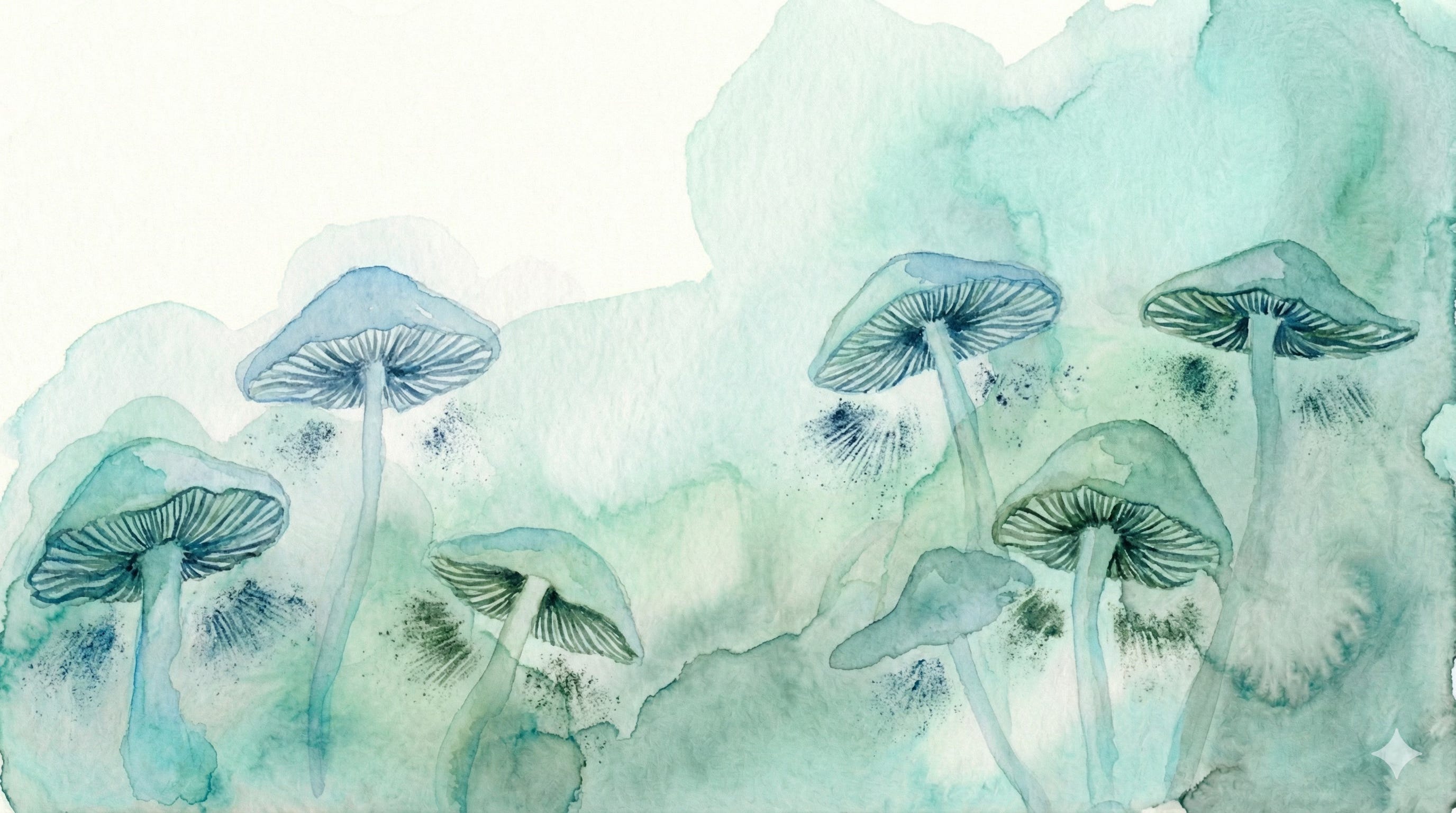
I’ve felt winter arriving for the past month or so. The way the Earth turns, almost like she’s tucking herself into bed at the end of each day, rolling over and pulling a blanket of fog around herself.
Sometimes I find myself resisting the winter — wanting to speed up instead of slowing down, turn outward rather than turning inward. A couple rainy, cold, or foggy days go by and I realize I haven’t been in the forest at all. By this time my nervous system is so full of input that it takes an enormous effort to get myself outside, but with determination I put myself in the car and drive to my favorite woods.
The first few minutes can be cacophonous. All the words, sounds, opinions, emotions, and energy of the human world comes pouring out of me at once. It is as if it has to be expelled through my own conscious awareness in order to be let go. I can fight it, trying to calm my mind with willpower alone, or I can surrender and let the whole thing come out of me like pressure being released from a hose.
And then…
The most wonderful, joyful, silence. Not a silence that is empty, but a silence full of life. The harmony of the moss interacting with the rock, the leaves settling into the forest floor, the mycelium networks digesting and resting beneath them, the billions of creatures making a home and expressing themselves so fully that they couldn’t comprehend a way not to do so. It is an experience of the world completely unbound by expectation, judgement, or fear.
You see, in the more-than-human world, each being deeply knows how to be themselves. The acorn knows how to become a tree. A squirrel knows only how to express his squirell-ness. He cannot do anything else.
In most indigenous languages, the word for each “thing” includes the Being-ness of that thing. The moss is being moss-like. The boulder is in the process of being stone. There is no way to convey that something simply “is” or “is not.”*
Our “modern” human worldview has traveled so far from this understanding. But it is still right there, alive in every breath we take, accessible to us if we just slow down enough to recognize it.
Winter calls us into this experience, like a mother pulling us into her womb. There is a part of us that remembers what it is like to feel completely and utterly part of something, not independent, alone, or isolated, as we so often feel.
For me, spending time in the forest is one of the only ways that I can remember this feeling. But the more that I soak it in, the more that I allow it to permeate even the parts of my psyche that stubbornly want to stay separate, the more I experience it in my daily life.
My relationship with the mushrooms also supports this embodied experience of oneness. When I find a flush of oysters in the forest, or even when I slow down while I walk enough to sense the mycelium network underfoot, I am instantly brought into their world. Mycelium is made up of a community of hyphae, each one acting on its own to find nutrients, move toward food, grow, expand, and reach. Yet it is only together as a community of individual consciousnesses that they create a mycelium network, which can produce fruiting bodies that we call mushrooms. They do not have a way to exist as a separated consciousness, with individual needs that believe themselves to be separate from the whole.
I aspire to exist like they do — to never feel as though my life is separate from those around me. To know deep in my being that we are all a part of the Earth’s body, each of us fulfilling our own part in this great orchestra of life.
Each of us must find what it is that connects us to this feeling. I don’t think it’s the same for everyone — for me it happens to be walking in the woods, but for you it could be any number of things that help you feel more connected to the whole. I find that there is almost a moment of critical mass — that if I spend enough time in nature, take care of my body and nervous system just enough, then I can more easily access this experience of Oneness in my daily life.
So, this is my invitation to you — find just one moment in your day to slow down. It doesn’t have to be some grand gesture, or a four-hour walk in the woods. Sometimes all we can manage is a deep breath in between buckling our seatbelt and starting the car, or slowing down the pace of our chopping as we prepare dinner. The nervous system responds to these changes as well, so if we are moving quickly it ramps us up into sympathetic (fight/flight/freeze) mode — whereas slowing down even a little helps to move us toward parasympathetic (rest/digest) mode.
Thanks for reading, and hopefully I’ll have more for you soon. Mush love.
-Little Mushroom 🍄
Footnotes:
*This conception comes only in “verb to-be” languages, like the colonizer languages (English, Spanish, Portuguese, etc.). For more on this, read “The Disobedience of the Daughter of the Sun” by Martín Prechtel